

NEED TO KNOW
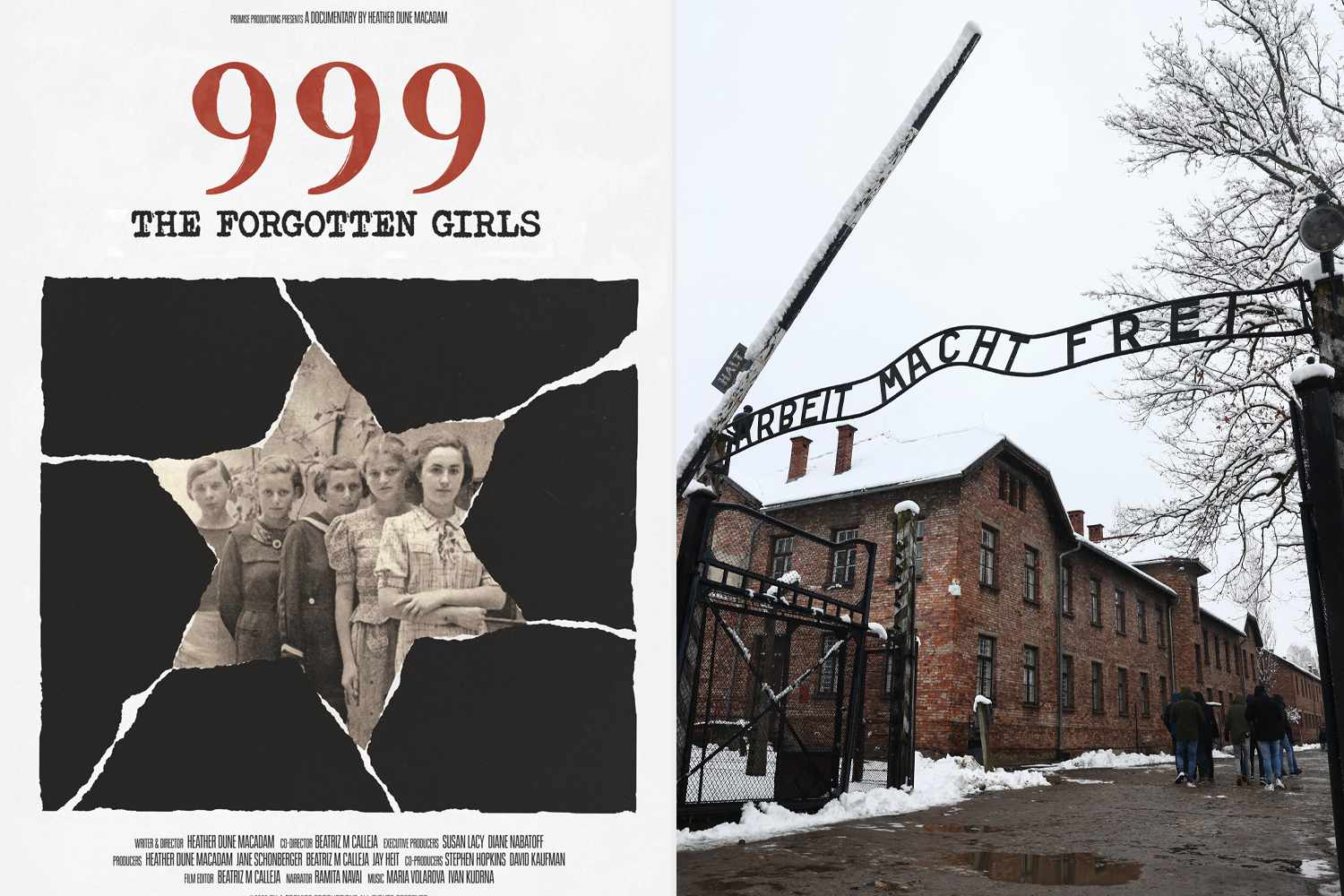
More than eight decades ago, a train filled with nearly 1,000 unmarried young Jewish women from Slovakia arrived at the gates of Auschwitz. The women had been told they were being sent to work to help support their families who had lost their means of income due to the anti-semitic legislation that was sweeping the region.
In reality, these women were a part of the first official transport of Jewish people to the concentration camp where approximately one million people were killed — most of them Jews.
“This is the first transport sent to Auschwitz by Office IV B 4 of the Reich Security Main Office (RSHA),” the United States Holocaust Memorial Museum explains. “This office, led by Adolf Eichmann, is responsible for coordinating the deportation of Jews from much of Europe to killing centers.”
Now, nearly 84 years later, their stories are being told in 999: The Forgotten Girls — a film based on a book written by director Heather Dune Macadam that first premiered in 2023. This year, in honor of Holocaust Remembrance Day on Jan. 27, which marks the 81st anniversary of the liberation of Auschwitz, the movie is being screened in New York City and L.A. to pay tribute to the women.
Dune Macadam remembers first becoming aware of the Holocaust as a child. Though not Jewish herself, her ancestors were abolitionists, and their family farm was a part of the Underground Railroad. “It was actually the first stop on the northern side of the Mason Dixon line,” she explains to PEOPLE.
Courtesy of Rutman family
“I learned about my ancestors and how they helped slaves hide and escape, and how brave they were and how loving and compassionate, and I remember saying to my mother, ‘If we had lived in Europe during World War II, would we have hidden Jews?’ And she said, ‘Absolutely,’ ” Dune Macadam continues. “I was so proud of that history.”
In 1995, Dune Macadam published her undergraduate senior thesis, which was a collaborative memoir she wrote with Auschwitz survivor Rena Kornreich Gelissen called Rena’s Promise: A Story of Sisters in Auschwitz.
“[Rena] and I really connected on this inability to believe that anybody could be racist or prejudiced. It’s just sort of shocking,” Dune Macadam recalls.
While living in Europe more than a decade later, Heather traveled to Auschwitz in honor of Gelissen and began filming what she thought was the start of a documentary.
“I literally thought it would be easier to make a documentary than to write a book,” she says.
Her plans changed, and she ultimately published 999: The Extraordinary Young Women of the First Official Jewish Transport to Auschwitz before releasing a film adaptation of her research in the form of the 2023 documentary.
As explained in the film, the number 9 was significant to Nazi leader Heimlich Hemler as it represented the “the end of a cycle — a final solution.” Though the language around the first transport of Jewish women often refers to 999, Dune Macadam explains that due to what she calls a “clerical error,” 997 women actually arrived at Auschwitz on March 25, 1942.
“The first day [the girls] got there, they stood outside for hours while they counted and recounted. because they couldn’t figure out why there weren’t 999,” she says, later adding, “There are two spaces where they typed it wrong — the numbers skip.”
Dune Macadam believes Hemler intended to have 999 Jewish women transported, as he did with the German non-Jewish female prisoners from Ravensbrück concentration camp who arrived in Auschwitz the same day, just before the transport from Slovakia.
In addition to the eight survivors of the first transport she was able to interview personally, Dune Macadam used existing interviews from resources like the USC Shoah Foundation and the Virginia Holocaust Museum. She knew from the beginning that her project would center around the first transport, she says, “because nobody else was focusing on it.”
Heather Dune
The “spine” of the film, as she explains it, is Edith Friedman Grosman, whose testimony and recollections are featured throughout. “I had filmed hours and hours of Edith and taped every conversation we ever had,” Dune Macadam says of Grosman, who died in July 2020, adding, “She remembers everything.”
Today, Dune Macadam says just one of the 997 women is still living, 100-year-old Antonia Rosenbaum, whom she calls “a beautiful, beautiful woman.”
As fewer first-hand witnesses to the Holocaust are left living today — a recent study says there are under 200,000 — Dune Macadam is determined to keep the memory of them alive.
She holds true the proverb that a person dies twice: once when their heart stops and again the last time their name is spoken.
“But I have added to that, for me, it’s the photographs. It’s not just the name. So that’s been my work,” she explains. “If I can find a photograph of a girl on the list, whether she survived or not, and I can show you her face as close [as] possible to the age that she was when she was deported. That’s going to change your perspective on what happened, and that’s what I wanted to do in the film. “
The Promise Production
For the New York City screening on Jan. 27 at the Streicker Cultural Center at Manhattan’s Temple Emanu-El, organizers hoped to fill the room with 999 people (including the ushers, as the venue only has 975 seats) to represent the women and girls on the March 1942 transport. Each ticket will have the name of one of the women, their list number as well as their age at the time of deportation printed on it. Additionally, the tickets will feature a QR code that connects to a new interactive archive that launches Tuesday night.
“The QR code will take you to that girl’s page, and you can click on it to see what her survival status was and if there’s a photo of her or any family information, or if she ever gave testimony. There will be connections to that and other images,” Dune Macadam says. “It’s really beautiful.”
Amid the current political climate in the U.S., Dune Macadam hopes the story resonates with both Jewish and non-Jewish people.
“Seeing our humanity in each other, that for me, is the message of the film,” she says. “We have such amazing role models in these women.”
Screenings of 999: The Forgotten Girls will take place on Jan. 27 at the Streicker Cultural Center at Temple Emanu-El in New York City at 6 p.m. ET and at the Oshman Family JCC in Palo Alto, CA at 7 p.m. PT. On Feb. 2, another screening will be held at the Dairy Arts Center in Boulder, Co. at 6 p.m. MT.
