

NEED TO KNOW
Ever wondered what it’s like working in an emergency room? Watch The Pitt.
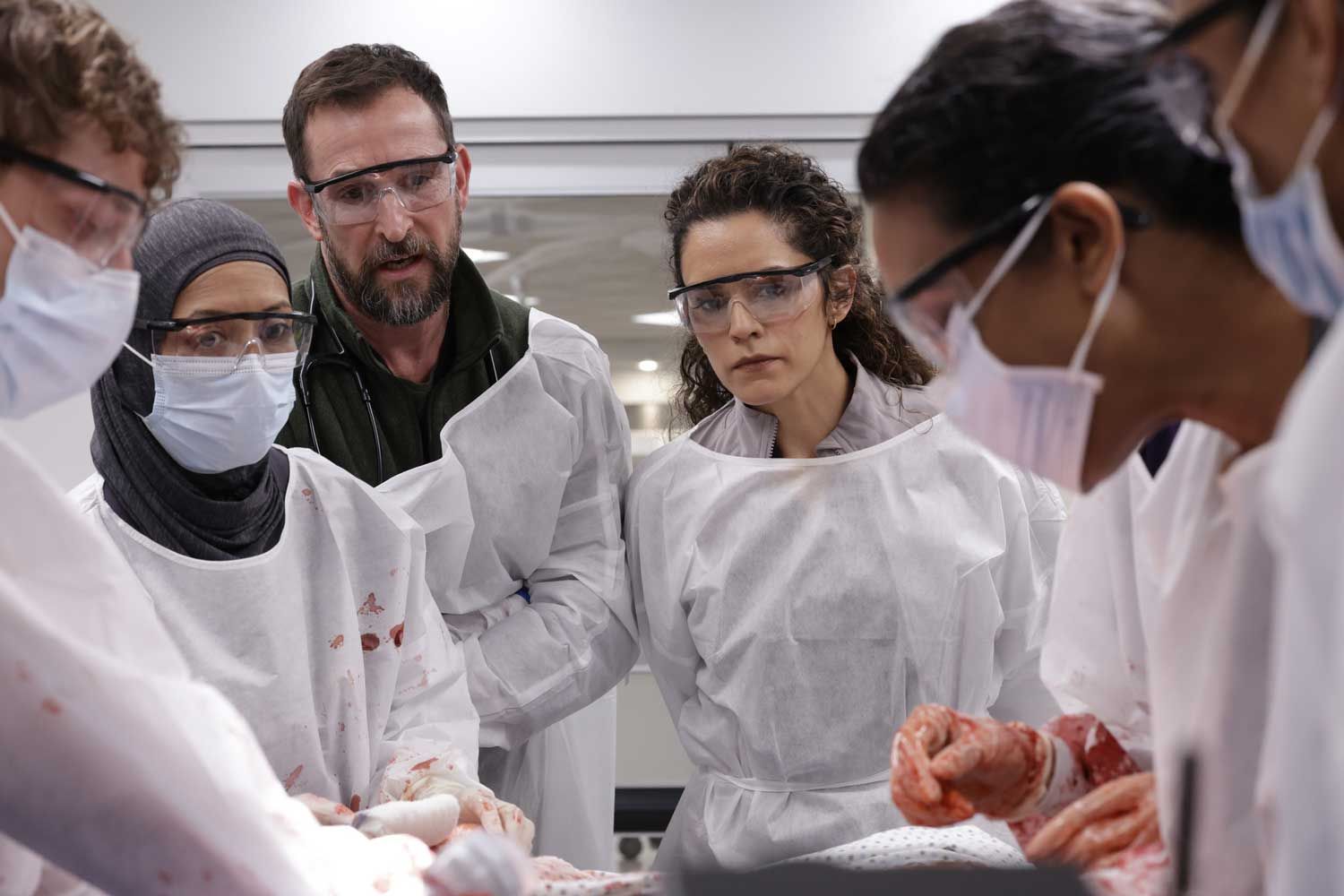
HBO Max’s heartstopping medical drama debuted in January 2025 and was an instant success, becoming one of the platform’s top five original premieres ever, according to the streamer. The show is led by ER veteran Noah Wyle, who plays Dr. Michael “Robby” Robinavitch, a chief attending doctor leading his Pittsburgh emergency room staff through a hectic shift. The first season featured 15 episodes, each detailing one hour of the chaotic workday; season 2, which follows the same format, premiered on Jan. 8, 2026.
The Pitt has garnered critical acclaim and earned several awards, including sweeping the 2025 Emmys and taking home two trophies at the 2026 Golden Globe Awards, including Wyle’s win for Best Performance by a Male Actor in a Drama Series. But the medical procedural isn’t just impressing the entertainment world — it’s also become a favorite of doctors and nurses for its realistic portrayal of emergency medicine.
“When you’re watching The Pitt, you’re reliving some very difficult moments during your career,” Dr. J. Mack Slaughter, an ER doctor in Texas, told PEOPLE in January 2026. “It’s a double-edged sword when a show gets it so right with the emergency room because you’re like, ‘Wait, I feel like I’m at work right now,’ in a beautiful way, but also in a difficult way.”
Here’s everything to know about what The Pitt gets right — and wrong — about emergency medicine, according to doctors, nurses and healthcare professionals.
How accurate is The Pitt?
Warrick Page/HBOMAX
The Pitt has earned high praise from the medical community for its depiction of life in the emergency department.
“The Pitt is one of the most medically accurate portrayals of emergency medicine I’ve seen on television,” Kristen Glick, an emergency medicine physician’s assistant at Yale New Haven Health’s Bridgeport Hospital in Bridgeport, Conn., tells PEOPLE.
To achieve such accuracy, the show’s creators R. Scott Gemmill and John Wells enlisted the help of doctors at nearly every level of production, per The New York Times. The medical cases seen on The Pitt are written by Joe Sachs, who worked as an emergency room doctor before becoming a television producer. The scripts are then reviewed by a team of medical consultants, who provide detailed notes on terminology, treatment and choreography.
There are also medical consultants on set to help guide the actors’ performances. Many of the background actors are actually nurses in real life – including Ned Brower, who plays ER nurse Jesse Van Horn on the show.
As a former ER nurse in Los Angeles, Brower was encouraged to offer “corrections” on set if anything seemed off or not entirely accurate.
“There was a bunch of eyes, including my own, doing that,” Brower told PEOPLE in April 2025. “And I think that’s what’s really made the show so special and unique and why people are loving it so much is because the details are so detailed.”
Is “The Pitt” a real place?
Courtesy of Max
Pittsburgh Trauma Medical Center, the hospital in The Pitt, is a fictional hospital.
However, it is based on Allegheny General Hospital, a large nonprofit hospital on Pittsburgh’s north side, according to PBS. All exterior shots of the hospital seen in the show, as well as shots of the lobby and the roof, were filmed on site at Allegheny.
Do emergency room physicians deal with the same volume of cases as in The Pitt?
Courtesy of Warrick Page/Max
Season 1 of The Pitt chronicles a single shift in hourly increments. During that time, doctors witness the aftermath of a mass shooting, a child drowning, an accidental overdose, a traumatic birth, measles cases, suspected sexual abuse and mercury poisoning, among others. But that volume of medically severe and complex cases in one shift is unlikely, according to several medical professionals.
“Where [the show] stretches reality is it’s probably the worst shift ever,” Dr. Matthew Harris, an attending pediatric emergency medicine physician at Northwell Health’s Cohen Children’s Medical Center in New Hyde Park, N.Y., tells PEOPLE.
Keri Bill, the nursing director for the emergency department at Stamford Hospital in Stamford, Conn., agrees. “Not every shift is nonstop crisis after crisis,” she says. “The show compresses a lot of high-stakes events into a single shift for dramatic effect, which makes it feel more relentless than real life.”
However, the chaotic pace and high stress environment shown on The Pitt is very true to real life. The nature of emergency medicine involves moving quickly and efficiently from patient to patient, often with little-to-no breaks or no emotional downtime.
“The rapid cycling from one patient who is near death, to the next room, where someone has a dental pain or a common cold, is incredibly factual,” Dr. Sarah Perman, an attending emergency medicine physician at Yale New Haven Hospital in New Haven, Conn., tells PEOPLE.
The Pitt’s depiction of the risks healthcare professionals face while working in an emergency room — such as Dana (Katherine LaNasa) getting assaulted by a disgruntled patient, Dr. Robby’s mental health struggles and Dr. Collins’ (Tracy Ifeachor) mid-shift miscarriage — was also spot-on, according to Dr. Melissa Langhan, a professor of pediatric emergency medicine at Yale University’s School of Medicine.
“ED physicians, particularly those who work night shifts, are at risk for pregnancy complications, cardiovascular disease and mental health disorders,” she tells PEOPLE. “There are physical consequences to the work that we do.”
Was The Pitt’s mass shooting response accurate?
Warrick Page/Max
Yes — and a hospital’s real-life response is “eerily familiar” to what is seen in episodes 12, 13 and 14 (“6:00 P.M.”, “7:00 P.M.” and “8:00 P.M.”) of season 1 of The Pitt, according to Dr. Harris, who is also the medical director for clinical preparedness at Northwell Health.
Once Dr. Robby and Dana receive the call alerting them to an active shooter at PittFest, the hospital enacts their MCI (mass casualty incident) protocol — which involves emptying the emergency room, huddling with staff, securing disaster preparedness equipment, determining point commanders for triage areas and then breaking off the staff into their designated sections.
“It was hyper-realistic,” Dr. Harris says. “Hospitals that don’t have an MCI plan should watch that episode and do what they did.”
Dr. Harris also revealed that he actually implemented an element of the MCI protocol seen on The Pitt into his own hospital’s plans: The use of different colored slap bracelets, instead of tags, to triage patients.
“What I stole from them were the slap bracelets,” he shares. “What’s nice about the slap bracelets is you just have to remember a color.”
What else does The Pitt get right?
Warrick Page/Max
Outside of its medical accuracy, the healthcare professionals consulted by PEOPLE all commended The Pitt for its ability to capture the non-clinical aspects of emergency room medicine — namely, the wide range of emotions that are experienced within an emergency department. In fact, Glick noted that some of the most accurate moments of the show “had very little to do with the medicine itself.”
“They were the quiet exchanges between colleagues, the conversations with families, the pauses in hallways and the unspoken understanding between providers,” she says. “Those moments — the human ones — felt the most true to life.”
Scenes in The Pitt where the physicians themselves have cracks in their typically calm facades — such as Dr. Robby breaking down in the makeshift morgue after failing to save the life of his stepson’s girlfriend or Whittaker (Gerran Howell) struggling to accept the loss of his first patient — were particularly striking for their reality, according to Dr. Langhan.
“The emotional burden that can be carried by ED physicians was well portrayed and accurate,” she tells PEOPLE. “I don’t know if patients and their families realize how much of this burden that we carry.”
The Pitt also manages to recreate with “scary” accuracy some of the most difficult moments in an emergency room, like when the mother of the college-aged student who took fentanyl-laced Xanax learns that her son is brain dead.
“There is something visceral about the scream of a mother who’s lost her child,” Dr. Harris says. “I thought you couldn’t reproduce [that]. And they did.”
What does The Pitt get wrong?
Warrick Page/Max
Though The Pitt is widely acclaimed for how much is accurate, there are minor moments in season 1 where the show missed the mark. In October 2025, Wyle revealed to PEOPLE the primary critique he received from healthcare professionals — and how he planned to fix it in season 2.
“The negative was that we didn’t have any respiratory therapists and we didn’t have any physical nurse practitioners, so we rectified that,” Wyle shared. “They’re going to be a lot of RTs and NPs in season 2.”
Doctors have also noted that the show struggles to depict cardiopulmonary resuscitation (CPR). However, it wasn’t for lack of trying: In January 2026, Gemmill told USA Today that the show spent six months working on a prosthetic to allow for realistic CPR, but had “mixed results.”
“The one thing that we have to fake because it doesn’t come off as realistic is CPR,” Gemmill told the outlet. “We’ve tried a million ways to do it. You just can’t.”
He continued, “If you’re doing CPR properly, you’re breaking ribs. And we can’t do that to our actors.”
The doctors’ ability on the show to rapidly — and always — come to a diagnosis is also not a totally accurate depiction of emergency medicine, according to Dr. Langhan.
“The Pitt does a good job about portraying the gray areas of medicine — but for the most part, they always find an answer,” she says. “In reality, there are many times when that doesn’t happen. We have to say, ‘I’m sorry you have had abdominal pain for three months, but I can’t tell you what it is from,’ or ‘I’m not sure what this rash is, but here’s something you can try and then follow up with your doctor.’ ”
Dr. Perman adds, “There is always a rapid diagnosis that would have taken more testing or more imaging to come up with that is more of an ‘a-ha moment’ on the show.”
