

NEED TO KNOW
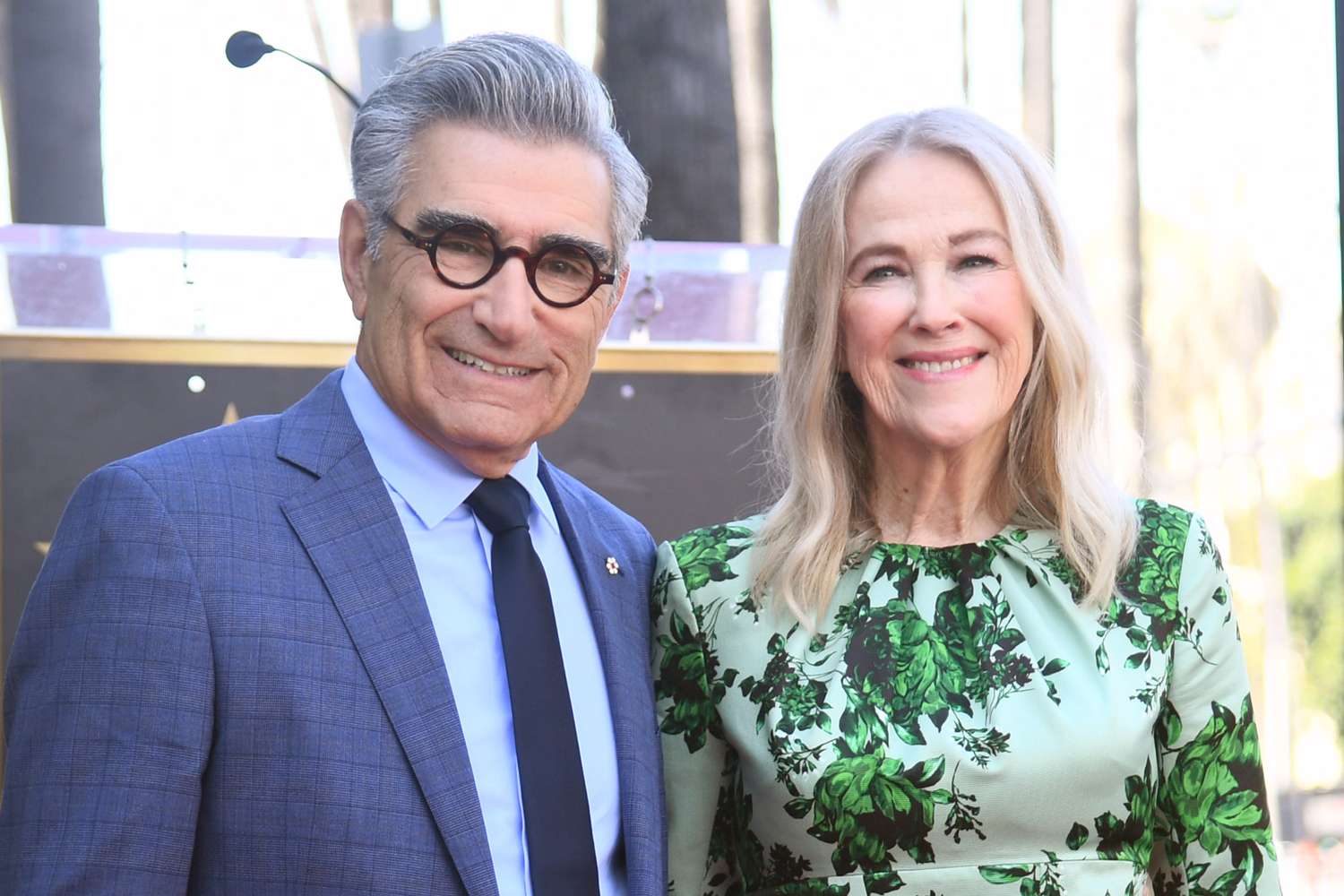
Catherine O’Hara was just 18 when she first met Eugene Levy at Toronto’s Second City Theater in the 70s. “I was a waitress, and he was in the cast,” she told PEOPLE during a double interview between the pair in 2016.
At the time, O’Hara — who died on Jan. 30 at age 71 — and Levy, 79, were promoting their show, Schitt’s Creek, which was in its second season and just about to come to the U.S. on the now-defunct channel PopTV. (It already had a devoted fanbase in Canada, and the series would later get picked up by Netflix, becoming a worldwide sensation.)
While they discussed the show and the thrill of working with Eugene’s son, Dan Levy, what they talked about most was their long working relationship and close personal friendship.
Below, read the interview in full, which includes tidbits about O’Hara and Levy’s time working alongside friends like John Candy, Martin Short and Gilda Radner at Second City in Toronto, and later starring in numerous Christopher Guest films together.
Charles Sykes/Bravo/NBCU Photo Bank via Getty
You’ve known each other for over 40 years. When did you first meet?
O’Hara: I saw Eugene onstage in Toronto, and he was with Martin Short, Gilda Radner, Victor
Garber and Paul Schaeffer. My brother Marcus was dating Gilda Radner at the time. Until Marty stole her away! Gilda got us tickets. And Marty invited us out for a drink afterwards with you guys. That was a big, big thrill for me.
Levy: Yes, I seem to remember Marcus’s little sister Catherine was there. Shortly after that, Second City in Toronto started up, and I met her again when she was working there.
O’Hara: I was working as a waitress, and you were in the cast, and I got to watch you every night. I also got to understudy Gilda Radner and Rosemary Radcliffe, and then I got to join the cast the following year. This was at the first Second City theater in Toronto. They were there for however many months, but they could never get a liquor license.
Levy: Yeah, we were there for five months but they had no liquor license, and people could only eat so many crepes and drink so many Cokes and they closed. But it was a great theater. It was very close to what the Second City theater was like in Chicago, and it was just an exciting place to work, whether you were a waitress or singer or performer. Catherine was quite young the first time she auditioned — she had a great audition I remember — but we thought she might be just a little
young to be onstage.
O’Hara: I joined the following summer, when I was 19.
Gail Harvey/Toronto Star via Getty
Did you have any inkling you’d still be working together 40 years later?
O’Hara: Isn’t that crazy? No, I had no idea I’d even be alive! It’s just nice to be alive, let
alone working with my dear friend.
Levy: Yeah, it’s nice to be working period, but it’s pretty amazing, A lot of friendships were
formed back at that time when we started, even though Marty Short and I went
to school together and we already kind of knew each other. But our friendship with Paul Schaeffer and Victor Garber and Martin Short is still ongoing. And certainly Catherine and Joe Flaherty and Dave Thomas and the late John Candy…we were friends for years and years and years, and we’re still very close friends.
You’ve played a married couple several times. Do you ever feel like one? Do you bicker?
O’Hara: I would love to think that we continue to challenge each other like a good married couple would do, and there are still many things that we don’t know about each other that we’re still
discovering. There was also a long stretch where we didn’t work together. We’d see each other socially, but we didn’t do much work together. It was only when Eugene and Chris wrote those
improvised movies [Waiting for Guffman, Best in Show] that we ended up playing a married couple a few times, and it was just great. I’d like to think we’re a different couple every time.
Wren Moloney/Castle Rock Ent/Auto Images/ZUMA Press Wire/Shutterstock
Levy: It’s really something that’s kind of developed after the movies with
Chris. That’s really where it started, because they kind of got a lot of attention and notoriety.
Waiting for Guffman hit big, not financially — it didn’t make a lot of money, but it kind of
became a cultish film with a lot of people in the industry. We weren’t a married couple in Guffman, but we were in the same small troupe together, and we were a funny pairing.
Was it hard trying not laugh in those improvised movies?
O’Hara: Yes! Certainly with Guffman, which was the first one we did as a group. A lot of us were together a lot in all the scenes, and Fred Willard was insanely funny. But you wouldn’t want to blow a take, because it was improvised and it was never going to happen that same way again, and you knew it was sabotage if you blew the take because you laughed. So Eugene, he would so be dying to laugh, so he’d lower himself out of the frame.
Moviestore/Shutterstock
Levy: Yeah, it was the first time Chris and I had worked together too, and his character, Corky,
just got my funny bone. He had this ridiculous dance that he would do that I could seriously not
stop laughing at. I’m not a laugher, I’m really not an easy break onstage or anywhere, sadly,
but boy, he had my number. And Catherine’s right, there were times where he got me
laughing in front of the camera so hard but I didn’t want to blow the take, so I would get
down on my hands and knees behind everybody and crawl off the set.
O’Hara: And the scene would continue!
Levy: The scene would continue, and I would hope nobody would notice that I wasn’t there. But we
had great fun. We did have so many laughs over the next few movies, but we learned that it’s
really not good to laugh in the middle of those takes because those are moments that are really
hard to recreate.
How has it been working together again on Schitt’s Creek?
Levy: It’s pretty amazing, It’s a great show, and it really encompasses the comic sensibility
that we both set out to do, which is you want to make it real, you want to make it credible, you want it
grounded. These characters, and the tone of the comedy, have to be incredibly real so that
the audience has something to hang onto emotionally— the humor has to naturally come through character, which is something Catherine and I have been doing our whole careers. So that’s what we started out to make, and I feel pretty good that we ended up with a show that has that sensibility. It’s a lovely, real, funny, with a great cast and great characters that you want to watch. Catherine was our first choice for Moira Rose, and we got her and I’m just thrilled that she said yes to it.
O’Hara: Me too!
PopTV
Did you ever date back in the day?
O’Hara: I dated everybody at Second City! We were all in our late teens or early twenties, and
when you’re laughing with each other, or making someone laugh, that’s really sexy. Everyone
thought, wow, we’re making each other laugh, maybe we should date! But Eugene is a gentleman
and I’m the product of Catholic parents to there’s no real story there. Thankfully, we remained friends. But everybody tried dating everybody, though nothing lasted long-term. Except Eugene and
Deb, he met his wife [Deborah Devine] at the theater.
Levy: Yes. And that has lasted. That worked in a big way. Everybody went out with everybody else back then. It was fun and social.
How strange was it to learn about the subculture of Dog Shows for Best in Show?
Levy: Dog show people can be very cutthroat! It’s a strange world, because the people do take it very seriously.
O’Hara: I remember we were shooting the last scene where we took our dog Winky… Eugene took over to show him and win, and all the other people in the show, except for the main cast, were real dog owners or dog handlers. And Eugene does the scene where Winky wins, and three or four of the dog owners near me were like, ‘Why does he win? I don’t understand why your dog would win. My dog should win!’ And I was like, ‘Um, it’s in the script?’
